
I. Foreword: A Gentle Debate on “Rules” vs. “Freedom”
When it comes to makeup, there is never a shortage of so-called “shoulds.” Face shape dictates contouring placement; eye color limits eyeshadow palette choices; changing seasons determine skin tone warmth or coolness—these assertions form a fine-meshed net, cast over everyone standing before a mirror. Yet, true veterans understand that the only ironclad rule is this: makeup is deeply personal and depends entirely on your own preferences.
That said, when you find yourself staring blankly at a beauty counter or feeling overwhelmed by drawers overflowing with products, a few guiding principles to experiment with aren’t necessarily a bad thing. In early 2026, a “Contrast Makeup Theory” introduced on social media by a French makeup artist quietly began serving as a gateway for many to rediscover their own faces. It involves no product sales pitches and requires no complex tools; at its core lies simply a black-and-white filter and an honest assessment of your own “grayscale values.”
II. The Origins of the Theory: From the Photography Darkroom to the Vanity Mirror
Contrast is, fundamentally, a photographic term—the greater the disparity between highlights and shadows, the higher the image’s contrast. French makeup artist Aliénor transplanted this concept into facial aesthetics, defining it as “the difference in lightness between the face, eyes, eyebrows, and hair.” She created a simple set of black-and-white filters, categorizing both skin tone and contrast into three distinct levels, allowing users to pinpoint their own “grayscale coordinates” via a selfie.
The compelling appeal of this theory lies in its inclusivity. In her video, Aliénor cites Beyoncé as an example: the disparity between her hair color and skin tone is not drastic, placing her in the “low contrast” category. Zoë Kravitz, conversely, is classified in the “high contrast” camp because her eyes, eyebrows, and hair color are significantly darker than her skin tone. The theory claims to be applicable to all skin tones—this is not merely a rehash of Eurocentric color analysis, but rather a democratizing attempt to view the face as a composition of light and shadow.
It must be emphasized, however, that this is not the ultimate law of makeup. Aliénor herself repeatedly emphasizes that this is merely a starting point—a baseline you can tweak and adapt whenever you tire of your usual routine, or when you are just beginning your journey into the world of makeup.
III. Low Contrast: Maintaining an Ethereal Quality Amidst Softness
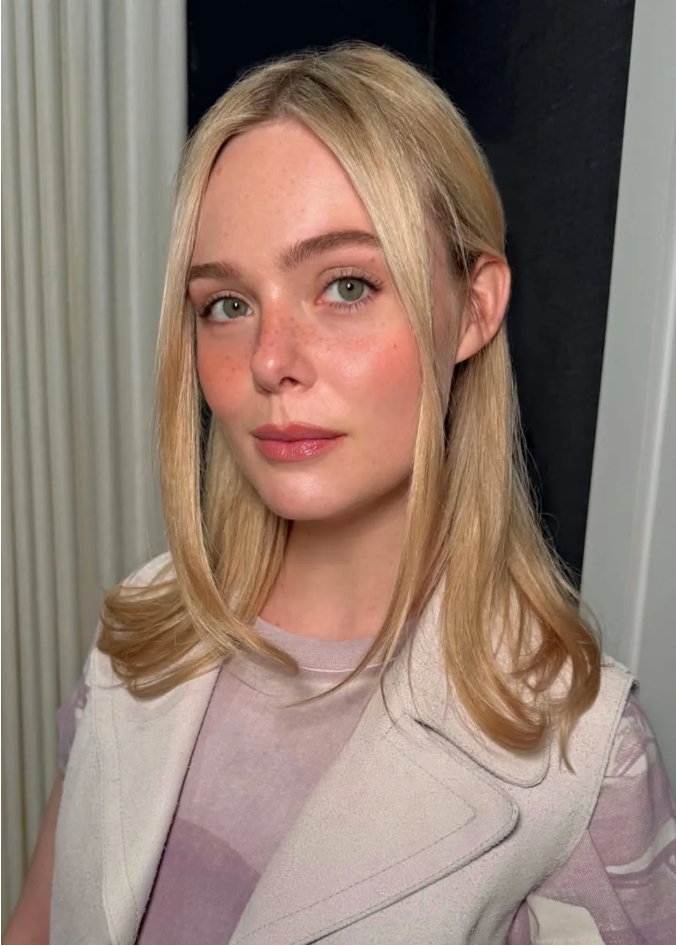
If your hair, eyes, and skin tone appear closely aligned in a grayscale image—almost dissolving into the same soft spectrum of shades—you belong to the “low contrast” group. Aliénor describes this state as one where “everything exists within the same tonal range—soft, ethereal, and never stark.”
Elle Fanning is a quintessential example of this facial type. For those with low contrast features, Aliénor recommends a “no-makeup makeup” look. This isn’t to say that bold, dramatic makeup is off-limits, but rather that a lighter touch tends to harmonize more naturally with one’s innate features. TikTok creator @rachellldaguanno’s experiment offers a compelling illustration: by applying only minimal contouring and blush—paired with mascara and lip gloss—she allowed her face to retain that delicate, “untouched” luminosity.
The paradox here is this: if a low-contrast individual attempts to force a high-contrast makeup look (such as heavy smokey eyes or a bold red lip), the result may actually feel like a “mask.” This isn’t because the makeup itself is flawed, but because it clashes with the underlying tonal harmony of the face. Of course, if that very clash is precisely the aesthetic you are aiming for, then that is an entirely different matter.
IV. High Contrast: Finding Moments of Softness Amidst Intensity
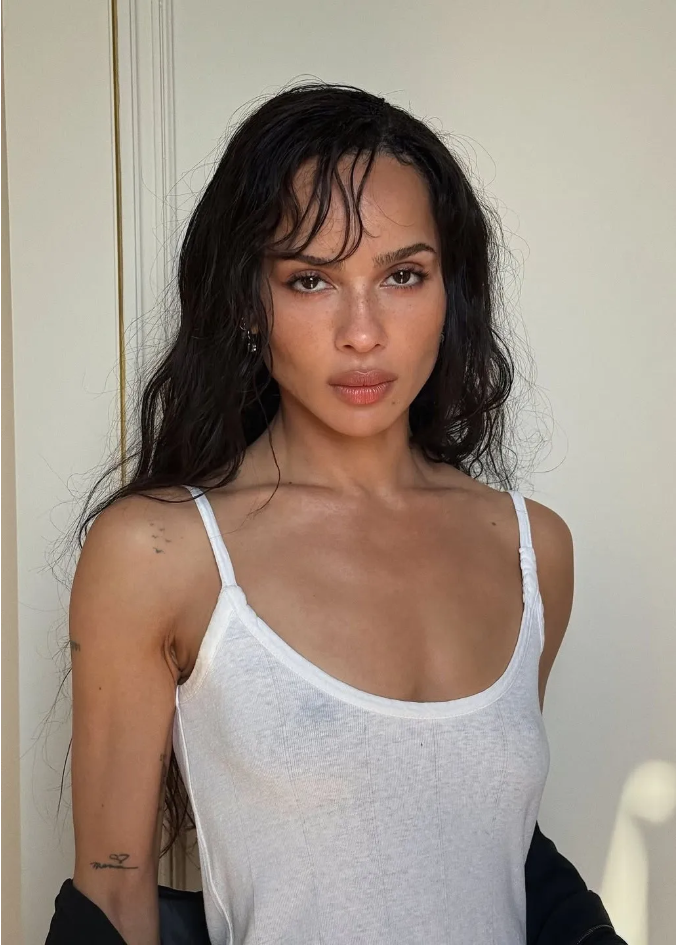
High-contrast faces are characterized by a significant disparity in lightness between their various elements—typically, very fair skin set against very dark hair, eyebrows, and eyes. This configuration possesses an inherent visual impact; as Aliénor notes, it “draws immediate attention to the face, though it can sometimes appear overly sharp.”
Consequently, the core strategy for high-contrast makeup revolves around either “consciously softening” or “consciously intensifying” one’s features—depending entirely on one’s mood that day. Emily Ratajkowski’s signature “smokey glam” look falls into the latter category: by employing rich smokey eyeshadow and a bold red lip, she pushes her natural contrast to a dramatic extreme. Conversely, if you prefer a softer aesthetic, you might opt for a red lip and blush with moderate saturation, or a “lighter” take on the smokey eye. Zoë Kravitz’s red-carpet looks often oscillate between these two extremes: at times featuring sharp, Gothic-style all-black eye makeup, and at others, displaying a restraint punctuated solely by a berry-hued lipstick. For those with high natural contrast, the potential range of makeup expression is vast—a gift, yet also a challenge.
V. Medium Contrast: Infusing Just the Right Amount of Intensity into the Balance
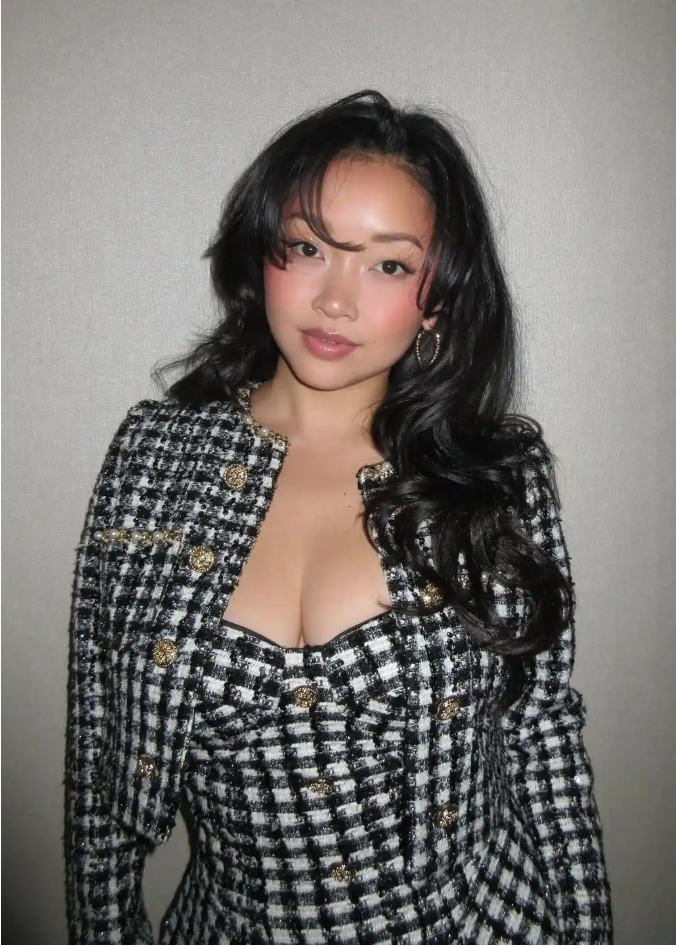
The territory lying between the two extremes is perhaps the most common—and the most nuanced—of all. Aliénor classifies herself within this category, candidly admitting that nude lipsticks once made her feel “like a ghost.” This illustrates that those with medium natural contrast sometimes need to actively introduce intensity to their look to ensure their makeup truly “converses” with their facial features.
Aliénor cites one of Zendaya’s red-carpet looks as a prime example: a luminous base, subtle bronze eyeshadow, and a rose-pink lip. This combination neither deliberately suppresses natural contrast nor pushes it to the extreme; instead, it gently layers a touch of “constructed harmony” atop the face’s inherent grayscale values.
Aliénor’s advice is both pragmatic and specific: opt for a lipstick with “just the right amount of intensity”—it needn’t be hyper-saturated, but it should possess more presence than your natural lip color. Pink and rose tones are safe bets. If your eyes are particularly dark, you might consider adding a touch of intensity to the eye area to bridge the visual gap between your bright whites and your skin tone; a subtle smoky eye is an excellent choice here. After experimenting with this approach—using pink blush and bronzer to blend around her eyes and cheeks, paired with a subtle brown winged liner—TikTok creator @tahiyabby concluded: “This might just be entering my regular rotation.”
VI. The Limits of Theory: When to Defy the Rules
Any trend is worth scrutinizing rather than blindly following. The limitation of the “contrast makeup” theory lies in its tendency to reduce the human face to a mathematical relationship of grayscale values, thereby overlooking the variables of texture, facial contours, personal aura, and one’s mood on any given day. A person with high natural contrast is perfectly free to step out wearing a completely “nude” makeup look, just as someone with low natural contrast might occasionally choose to wear a bold scarlet lip gloss to a dinner party. That very sense of “discord”—that feeling of something being slightly “off”—is, at times, precisely where true style resides. Aliénor’s theory functions more like a mirror than a map. It allows you to clearly perceive the underlying structure of your facial features, leaving it entirely up to you to decide whether to work with that structure, refine it, or radically subvert it. In an era where beauty trends are increasingly driven by algorithms and viral traffic, this deliberate, unhurried process—one of “understanding first, then choosing”—feels all the more precious.
VII. Practical Notes: How to Begin Your “Grayscale Experiment”
The first step is to strip away color. Convert a selfie into black-and-white to observe the interplay between your hair, eyebrows, eyes, and skin tone—do they float gently within the same tonal range, or do they stand in stark contrast to one another? There is no need to strive for precise categorization; identifying a “general leaning” is sufficient as a starting point.
Next comes the fine-tuning of your makeup application. Those with low contrast might try paring down their routine, aiming for products that seem to “vanish” into the skin; those with high contrast might experiment with varying intensities of smoky eyes and bold red lips; while those with medium contrast might search for that delicate tipping point—the precise saturation level for lip color and blush that ensures they are “just visible.”
Keeping a record is invaluable—not for the sake of social media, but for your own benefit. After several days of experimentation, you will gradually begin to discern which combinations make your face look and feel “right,” and which ones create a subtle sense of discord. Cultivating this intuitive sense of recognition brings you far closer to the true essence of makeup artistry than any theoretical framework ever could.
Between Grayscale and Color
Ultimately, the theory of contrast-based makeup offers a fresh perspective on how we view ourselves—not through the lens of color-based labels (such as “cool-toned,” “warm-toned,” “Spring,” or “Winter”), but through the most fundamental relationship of all: that of lightness and darkness. It serves as a reminder that makeup is never about “fixing” something; rather, it is about finding the specific interplay of light and shadow on the canvas of your face that feels most authentic and comfortable to you.
In the beauty landscape of 2026, this impulse to return to basics may well be an act of resistance—a resistance against hyper-consumption, against the dictates of algorithms, and against the anxiety that tells you, “You simply must own this limited-edition shade.” A simple black-and-white filter, a few products you already own, and a touch of patient experimentation may be all it takes to forge a new sense of harmony with the reflection staring back at you from the mirror. After all, the very best makeup is always the kind that makes you forget you’re wearing any makeup at all.

